Medieval French Lyric Across Linguistic Borders: Music, Imitation, and Intertextuality
The ERC-Starting Grant project MUSICA FRANCA (HORIZON-ERC, ID: 101219609) investigates the role music played as a shared medium of communication across medieval Europe, enabling texts and ideas to travel across linguistic and political borders.
Medieval poets and performers thought of melodic borrowing and re-use as constitutive to the process of creation. By investigating melodic imitation, intended as a range of techniques (from borrowing stylistic features to the reuse of entire melodies) in French, Galician-Portuguese, German, and Occitan lyric, from the 12th up to the first half of the 14th century, MUSICA FRANCA proposes to uncover a network which today appears to us as silent, but which profoundly shaped European intellectual history.
AIMS
To define a cohesive methodology for analysing melodic imitation across European lyric repertories, leveraging digital tools to uncover hitherto unknown melodic connections.
To provide a new methodological framework for the study of medieval aesthetics of imitation. This transdisciplinary methodology aims to integrate literary, philological, and musicological studies with network theory, in a translingual perspective.
To offer new topographic representations of medieval Europe, tracing the networks expressed by exchanges of texts and music and their interrelations with their cultural contexts.
To demonstrate how processes of imitation across different linguistic areas contributed in shaping European identities and a shared musical culture.
The project will produce a series of monographs on musical imitation in medieval Europe, along with two main digital outputs:
The complete digital edition of the music of the trouvères.
An interactive platform of geographical networks of musical imitation in medieval Europe.
TEAM (Recruitment: May-August 2026. Start date: 1 November 2026)
This is an informal notice for prospective applicants: details may change in the official job advertisement (to be published in Spring 2026).
MUSICA FRANCA aims to create a lively environment for early-career researchers working on medieval lyric and its music across multiple vernacular traditions, fostering intellectual exchange and a shared commitment to excellence. It will provide a space to work, collaborate, and develop interdisciplinary skills combining philology, literary studies, musicology, and digital humanities, laying the foundations for innovative academic careers.
One postdoctoral fellowship with a focus on Galician-Portuguese medieval lyrics and music ("Contratto di ricerca" 2, renewable for a further 2 years, 4th and highest tier, € 38.582 gross salary per year).
One postdoctoral fellowship with a focus on Middle High German lyrics and music ("Contratto di ricerca" 2, renewable for a further 2 years, 4th and highest tier, € 38.582 gross salary per year).
One postdoctoral fellowship specialised in Data analysis, Geospatial representation, or Digital Humanities with a strong technical background ("Contratto di ricerca" 2 years, 4th and highest tier, € 38.582 gross salary per year).
One doctoral fellowship focusing on Occitan lyric and music (3 years, € 16.243 per year plus research funds and bonuses, social security, contributions, and mobility funding up to 50% of the fellowship amount for research periods abroad) . THIS POSITION IS NOW CLOSED
One junior researcher to participate to the digital edition of the trouvère melodic corpus ("Incarico di ricerca (art. 22-ter)", 1 year, € 22.500).
Two senior academics (1–2 months), by invitation, to serve as advisors.
TEAM'S EXPECTED OUTPUTS
All team members will work with linguistic lyric traditions in connection to the French lyric corpus and its music. A background in Romance philology, medieval literary studies, or medieval musicology is expected, and first-hand experience in Digital Humanities and a predisposition to acquire advanced skills in this domain are highly valued.
The project and team will be based in Sapienza University of Rome. The team members will work on a daily basis in a dedicated lab space located in the Lettere e Filosofia building (main campus).
The project is built around a collaborative and practice-based research environment involving shared use of laboratory facilities, dedicated computing resources, musical recording equipment, performance-based activities, peer-to-peer training, informal seminars, and collective methodological development.
Designated off-term periods will be devoted to independent work outside the laboratory, and secondments at institutions abroad are encouraged. However, because the project's research practice relies on frequent in-person collaboration and activities, the position is not compatible with remote work.
The official language of the lab will be English: international candidates are welcome and encouraged to apply. In order to allow for optimal integration into the Italian academic environment, the project will foster and fund Italian language learning for non-native speakers.
Team members will receive training in computational tools and techniques applied to the study of the Middle Ages (databases, data analysis, geographical representations, web applications), as well as in philology and medieval musicology. They will share their expertise in workshops, seminars, tutoring, and day-to-day collaboration within the lab.
Expected outputs:
Collaborative research to identify and study connections between French melodies and texts and those of other linguistic and cultural traditions, integrating literary and musicological approaches.
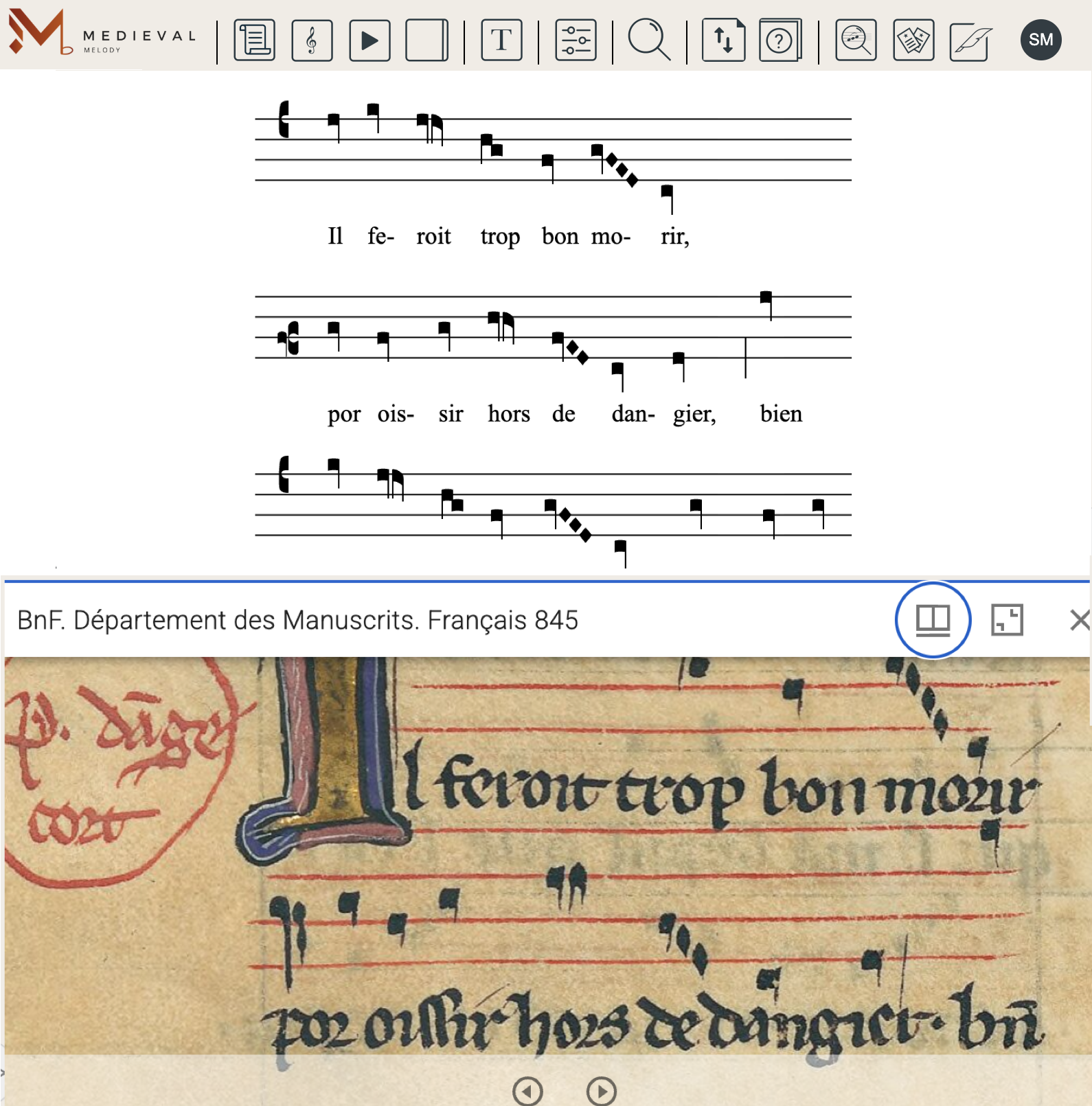
Transcription and edition of medieval music with MedMel, with particular regard for the French corpus.
Collaboration in building the project's digital platform.
Participation in the recording of performances for research purposes in the laboratory.
Organization of academic events at Sapienza Univerisity.
Publication of academic outputs appropriate to the type of appointment:
1 and 2: A monograph and 2–3 journal articles (over four years).
3: A digital platform and at least one journal article; support for computational analysis and data representation.
4: PhD dissertation.
5: Transcriptions of French medieval music.
6: Serve as advisor, give one public lecture, with the possibility of co-authoring select publications.
TEAM RESOURCES
Team members will have access to dedicated lab space and equipment. Postdoctoral fellows and the PhD candidate will benefit from substantial research funding, including support for books, materials, training, and travel to conferences and research visits. The project will also cover publication costs for open-access articles in leading international journals and book series.
CONTACT
Prospective applicants are welcome to contact Prof Stefano Milonia (stefano.milonia [at] uniroma1.it) for further information.